- What Is Artificial Intelligence?
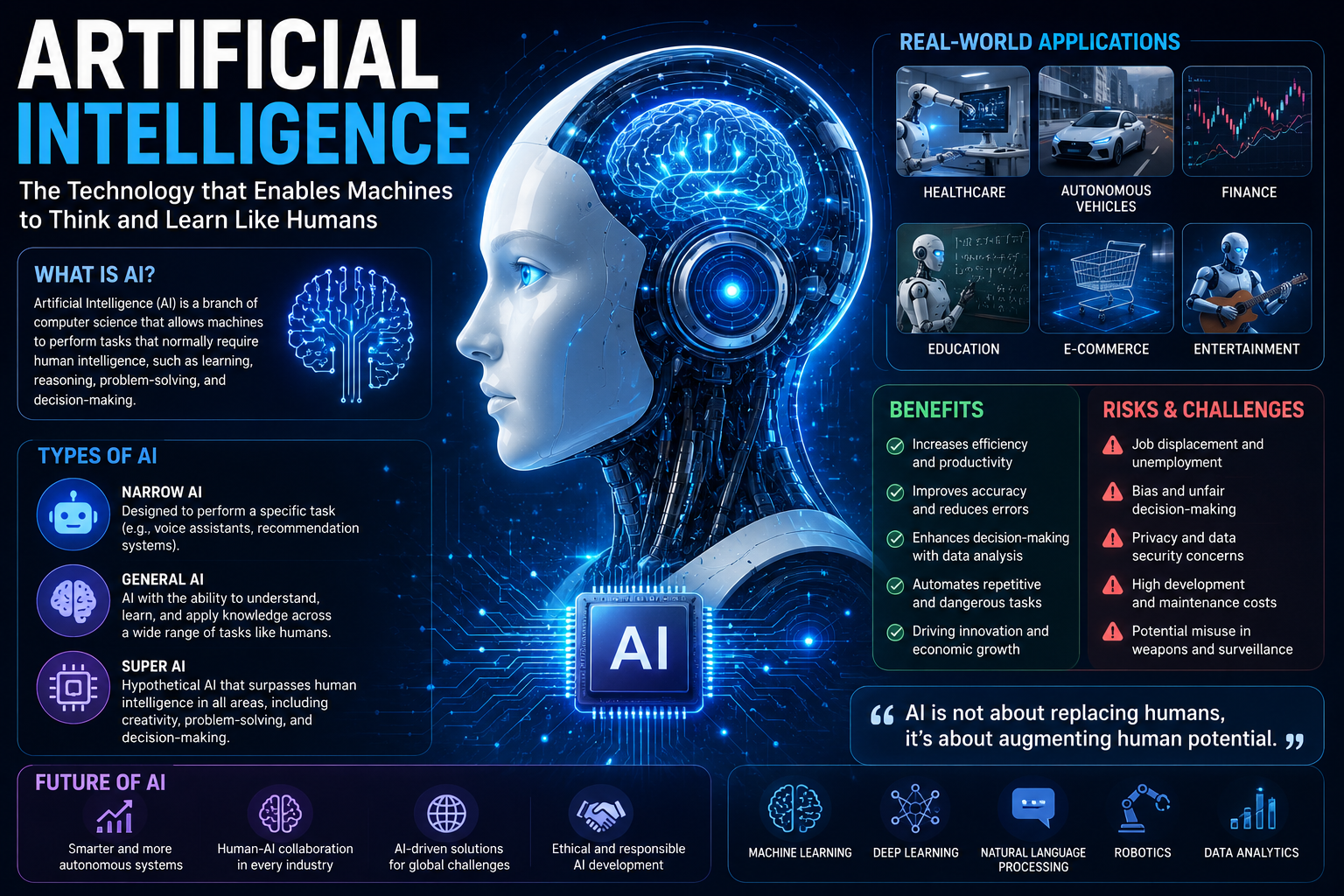
- Artificial Intelligence (AI) is the science of building computer systems that can perform tasks that normally require human intelligence — such as understanding language, recognizing images, making decisions, and solving problems.
AI is not a single technology. It is a broad field encompassing many techniques, approaches, and applications — from simple rule-based systems to sophisticated neural networks that learn from vast amounts of data.
Simple Definition
AI = teaching machines to think, learn, and act intelligently. Just as humans learn from experience, AI systems learn from data.
A Brief History of A
Era Key Events Significance
1950s Alan Turing proposes the Turing Test; first AI programs written Birth of AI as a field
1960s–70s Early expert systems; first AI winter due to unmet expectations Early optimism & setbacks
1980s–90s Machine learning emerges; Deep Blue beats chess champion Kasparov Practical AI applications grow
2000s Big data era; internet provides massive training datasets Data-driven AI accelerates
2010s Deep learning revolution; ImageNet breakthrough; AlphaGo; GPT-1 Modern AI renaissance
2020s GPT-3/4, Claude, Gemini; generative AI goes mainstream AI in everyday life
2026 Multimodal AI, autonomous agents, AI reasoning models dominate Approaching general-purpose AI
Types of AI
Narrow AI (ANI): Designed for one specific task (e.g. chess, image recognition, spam detection). All current AI is narrow AI.
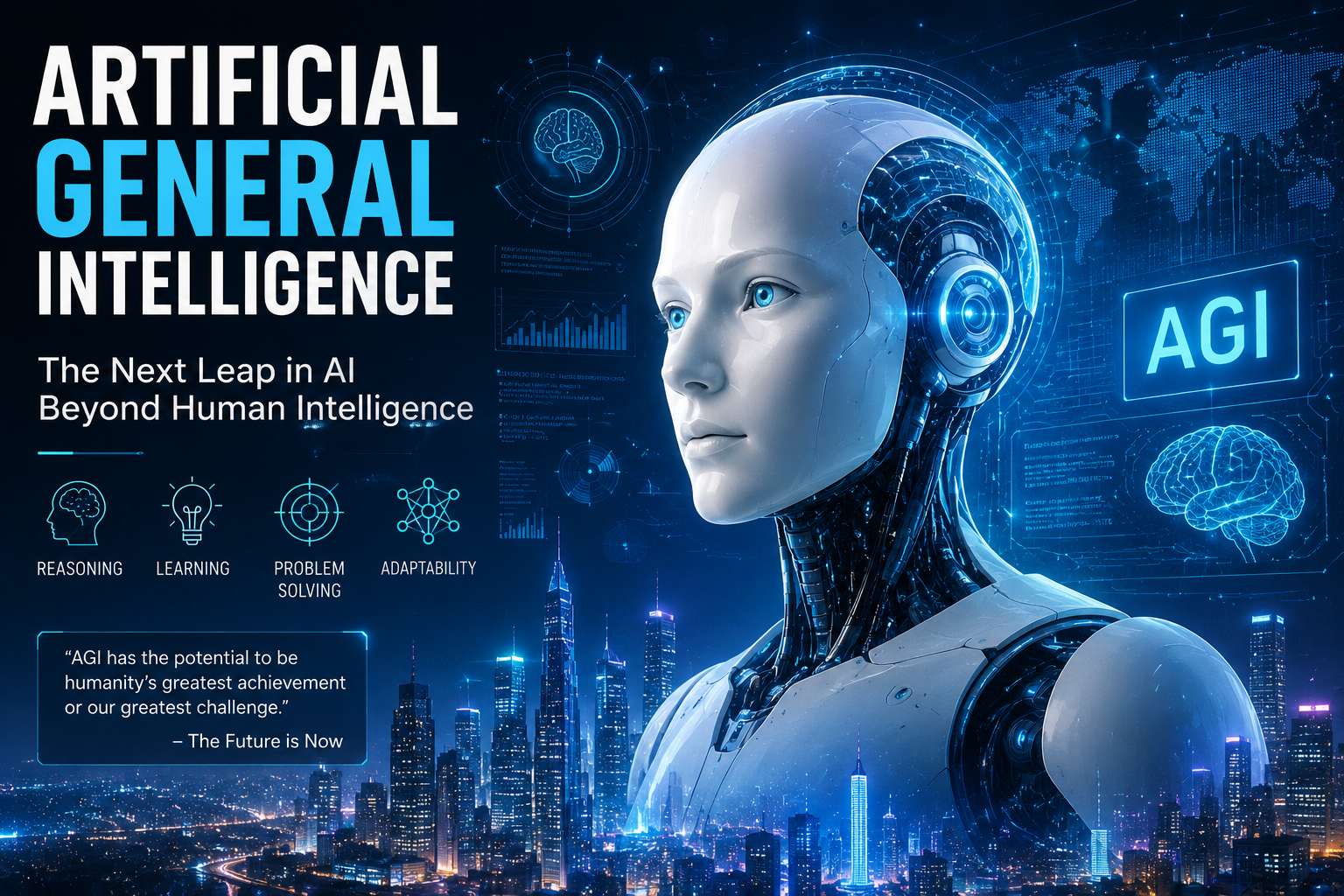
General AI (AGI): Hypothetical AI that can perform any intellectual task a human can. Not yet achieved.
Superintelligent AI (ASI): AI that surpasses human intelligence across all domains. Theoretical and far-future concept.
- How AI Works
Modern AI systems learn patterns from data rather than following hand-coded rules. This is known as machine learning — the most important paradigm in contemporary AI.
Machine Learning (ML)
Machine learning is the process by which AI systems improve from experience. Instead of being programmed with explicit instructions, ML models are trained on large datasets and learn to make predictions or decisions by identifying statistical patterns.
ML Type How It Works Example
Supervised Learning Learns from labeled examples (input-output pairs) Email spam detector
Unsupervised Learning Finds hidden patterns in unlabeled data Customer segmentation
Reinforcement Learning Learns by trial-and-error, rewarded for correct actions Game-playing AI (AlphaGo)
Semi-Supervised Combines small labeled dataset with large unlabeled data Medical image analysis
Self-Supervised Creates its own labels from raw data structure Large Language Models (LLMs)
Deep Learning & Neural Networks
Deep learning uses artificial neural networks — computational systems loosely inspired by the human brain. These networks consist of layers of interconnected nodes (neurons) that transform data progressively, extracting increasingly abstract features.
Deep learning is responsible for most of the breakthroughs in computer vision, natural language processing, speech recognition, and generative AI over the past decade.
Why ‘Deep’?
The word ‘deep’ refers to the many layers in a neural network. Early networks had 2-3 layers. Modern large language models like GPT-4 have hundreds of layers with billions of parameters — the numerical weights the model adjusts during training.
Large Language Models (LLMs)
LLMs are the technology powering ChatGPT, Claude, Gemini, and other modern AI assistants. They are trained on hundreds of billions of words from the internet, books, code, and other sources, learning to predict and generate human-like text.
Through this training, LLMs develop surprising capabilities: writing code, translating languages, answering questions, summarizing documents, and reasoning through complex problems.
Model Creator Notable Capability
GPT-4 / GPT-4o OpenAI Multimodal reasoning, coding, broad knowledge
Claude 3.5 / Claude 4 Anthropic Safety-focused, long context, nuanced reasoning
Gemini Ultra Google DeepMind Science benchmarks, Google ecosystem integration
Llama 3 / 4 Meta AI Open-source, customizable, research-friendly
Mistral Large Mistral AI Efficient, European, multilingual
Grok 2 xAI Real-time web data, uncensored responses
DeepSeek R2 DeepSeek Strong math & coding, cost-efficient
- Key AI Technologies in 2026
Generative AI creates new content — text, images, audio, video, and code — that did not previously exist. It represents the most commercially impactful AI development of the 2020s, enabling anyone to produce professional-quality content with simple text prompts.
Modality What It Creates Leading Tools
Text Articles, emails, code, summaries, stories ChatGPT, Claude, Gemini
Images Artwork, photos, logos, illustrations Midjourney, DALL-E 3, Stable Diffusion
Audio Music, voiceovers, sound effects Suno, ElevenLabs, Udio
Video Short clips, animations, full scenes Sora (OpenAI), Runway, Pika
Code Software, scripts, web apps GitHub Copilot, Cursor, Replit AI
3D / Design 3D models, product designs, architecture Point-E, Luma AI
Computer Vision
Computer vision enables machines to interpret and understand visual information from images and videos. Applications range from facial recognition to medical imaging to self-driving vehicles.
Object Detection: Identifying and locating objects in images or video (used in autonomous vehicles, security)
Facial Recognition: Identifying individuals from facial features (used in unlocking phones, law enforcement)
Medical Imaging: Detecting cancer, tumors, and diseases in X-rays and MRI scans
OCR: Optical Character Recognition — reading text from images and documents
Video Analysis: Understanding actions, events, and patterns in video footage
Natural Language Processing (NLP)
NLP enables computers to understand, interpret, and generate human language. It is the foundation of chatbots, translation services, search engines, and voice assistants.
Sentiment Analysis: Determining if text expresses positive, negative, or neutral sentiment
Machine Translation: Translating between languages (Google Translate, DeepL)
Named Entity Recognition: Identifying people, places, organizations, and dates in text
Text Summarization: Condensing long documents into concise summaries
Question Answering: Providing accurate answers to natural language questions
AI Agents & Autonomous Systems
AI agents are systems that can perceive their environment, make decisions, and take actions to achieve goals — often over multiple steps, without continuous human instruction. In 2026, agents represent the frontier of practical AI deployment.
What Makes an AI Agent?
An AI agent combines a powerful language model with tools (web search, code execution, file access) and memory (storing context across sessions). It can plan, execute multi-step tasks, check its own work, and adapt when things go wrong — operating much like a digital employee.
Examples: Claude Computer Use, OpenAI Operator, AutoGPT, Devin (coding agent), HubSpot AI agent
Use Cases: Research automation, software development, data analysis, customer support, scheduling
Embodied AI combines machine learning with physical robots, enabling machines to navigate, manipulate objects, and interact with the real world. This is one of the most challenging frontiers in AI because the physical world is messy, unpredictable, and unforgiving of errors.
Robotics & Embodied AI
Humanoid Robots: Figure AI, Tesla Optimus, Boston Dynamics Atlas — general-purpose physical AI
Industrial Robots: Automated manufacturing, warehouse logistics (Amazon Robotics, ABB)
Autonomous Vehicles: Self-driving cars (Waymo, Tesla FSD), delivery drones (Amazon, Wing)
Medical Robots: Surgical assistants (da Vinci Robot), rehabilitation systems
- AI Applications Across Industries
Industry Key AI Applications Impact
Healthcare Diagnosis, drug discovery, personalized medicine, clinical notes Very High
Finance Fraud detection, algorithmic trading, credit scoring, robo-advisors Very High
Education Personalized tutoring, automated grading, adaptive curricula High
Legal Contract review, legal research, document summarization High
Retail & E-commerce Recommendation engines, demand forecasting, customer service bots High
Marketing Content creation, ad targeting, customer segmentation, analytics High
Manufacturing Predictive maintenance, quality control, supply chain optimization High
Agriculture Crop monitoring, yield prediction, precision farming Medium
Energy Grid optimization, demand forecasting, predictive maintenance Medium
Entertainment Content recommendation, AI-generated music/video, game AI High
Transportation Route optimization, autonomous vehicles, traffic management High
Cybersecurity Threat detection, anomaly detection, automated response Very High
AI in Healthcare — Deep Dive
Healthcare is arguably the domain where AI can have the most profound human impact. In 2026, AI systems match or exceed specialist physicians in several diagnostic tasks.
Cancer Detection: Google DeepMind’s AI detects breast cancer with greater accuracy than radiologists in clinical studies
Drug Discovery: AI reduces drug development timelines from 10+ years to 2-3 years (Insilico Medicine, Recursion)
Clinical Summarization: AI tools automatically generate patient notes, reducing physician burnout by 30-40%
Genomics: AI analyzes DNA sequences to predict disease risk and guide personalized treatment
Mental Health: AI-powered therapy apps (Woebot, Wysa) provide scalable mental health support
- The AI Ecosystem: Companies & Players
Company Key Products Focus / Philosophy
OpenAI GPT-4o, o3, DALL-E 3, Sora, Whisper Commercial leadership; AGI mission
Anthropic Claude 3.5 Sonnet, Claude 4 Safety-first AI; Constitutional AI
Google DeepMind Gemini Ultra, AlphaFold, Imagen Scientific AI; multimodal research
Meta AI Llama 3/4, SAM, AudioCraft Open-source AI; academic collaboration
xAI Grok 2, Aurora Real-time information; less restricted
Mistral AI Mistral Large, Mixtral European, efficient, open-weight models
DeepSeek R1, V3, Coder models Cost-efficient reasoning models
Infrastructure & Platforms
NVIDIA: GPUs that power virtually all AI training (H100, Blackwell chips); the ‘picks and shovels’ of the AI gold rush
Microsoft Azure AI: Enterprise AI cloud; exclusive OpenAI partnership; Copilot across Office 365
Google Cloud AI: Vertex AI platform; TPU hardware; Gemini integration
Amazon AWS: Bedrock AI platform; Trainium chips; broad model marketplace
Hugging Face: Open-source model hub; 500,000+ models; democratizing AI access
Key AI Products in 2026
ChatGPT (OpenAI): World’s most widely used AI assistant; 200M+ users
Claude (Anthropic): Preferred for long-form writing, coding, and safety-critical applications
Gemini (Google): Deep Google Workspace integration; multimodal and real-time web access
GitHub Copilot: AI pair programmer; used by 1M+ developers
Midjourney: Leading AI image generation platform
Perplexity AI: AI-powered search and research assistant
- AI Ethics, Risks & Safety
Challenge Description Severity
Bias & Discrimination AI trained on biased data produces biased outputs (hiring, lending, policing) High
Misinformation AI generates convincing fake text, images, video (deepfakes) Very High
Privacy AI systems trained on personal data; surveillance capabilities High
Job Displacement Automation replaces knowledge workers; economic disruption High
Hallucination AI confidently states false information as fact Medium-High
Black Box Problem AI decisions are opaque and hard to explain or audit High
Concentration of Power AI benefits flow mainly to large corporations and wealthy nations High
Autonomous Weapons AI used in lethal military systems without human oversight Very High
Environmental Cost Training large AI models consumes enormous energy and water Medium
AI Safety Approaches
AI safety is the field dedicated to ensuring AI systems behave as intended and do not cause unintended harm. As AI becomes more capable, safety research becomes more critical.
Constitutional AI: Training AI with explicit ethical principles encoded into its values (Anthropic)
RLHF: Reinforcement Learning from Human Feedback — humans rate AI responses to reward good behavior
Red Teaming: Adversarial testing — deliberately trying to break or manipulate AI systems to find weaknesses
Interpretability Research: Understanding what happens inside neural networks; making AI decisions explainable
Alignment Research: Ensuring AI goals remain aligned with human values as capabilities increase
AI Auditing: Independent third-party evaluation of AI systems before deployment
The Hallucination Problem
AI language models sometimes ‘hallucinate’ — generating text that sounds authoritative but is factually wrong. For example, citing non-existent research papers, inventing statistics, or stating false historical facts. Always verify important AI outputs against authoritative sources.
Responsible AI Principles
Leading organizations have adopted responsible AI frameworks. Core principles include:
Transparency: Users should know when they are interacting with AI and how decisions are made
Fairness: AI systems should not discriminate based on race, gender, religion, or other protected characteristics
Accountability: There must be clear human responsibility for AI decisions and their consequences
Privacy: AI systems should handle personal data with appropriate protection and consent
Safety: AI systems must be tested rigorously before deployment in high-stakes contexts
Human Oversight: Humans must retain meaningful control over consequential AI decisions
- AI and the Future of Work
7.1 Which Jobs Are Most at Risk?
Job Category Risk Level Reason
Data entry & processing Very High Easily automated by AI and RPA tools
Customer service representatives High AI chatbots handle most routine queries
Paralegals & legal assistants High AI handles document review and research
Radiologists (routine cases) High AI matches expert diagnostic accuracy
Translators High AI translation quality approaches human level
Financial analysts Medium-High AI automates data analysis and reporting
Software developers Medium AI assists but human judgment still needed
Teachers Low-Medium AI supplements but cannot replace human connection
Plumbers & electricians Low Physical dexterity in varied environments is hard to automate
Mental health therapists Low Empathy and human connection remain irreplaceable
New Jobs AI Is Creating
AI Prompt Engineer: Crafting effective prompts to elicit optimal AI outputs
AI Trainer / RLHF Specialist: Rating and improving AI responses through human feedback
AI Ethics Officer: Ensuring responsible AI deployment within organizations
AI Integration Consultant: Helping businesses adopt and optimize AI tools
LLM Fine-tuning Specialist: Customizing foundation models for specific business needs
AI Safety Researcher: Studying and mitigating risks from advanced AI systems
Historical Perspective
Every major technological revolution — the printing press, steam engine, electricity, computers, internet — initially caused fear of mass unemployment. Each ultimately created more jobs than it eliminated, though the transition caused significant disruption. AI may follow a similar pattern, but the speed and breadth of change may be unprecedented.
Skills That Will Remain Valuable
Critical Thinking: Evaluating AI outputs, identifying errors, and making nuanced judgments
Creativity: Original ideation, artistic vision, and novel problem framing
Emotional Intelligence: Empathy, leadership, conflict resolution, and human connection
AI Literacy: Understanding how to use, evaluate, and work alongside AI tools effectively
Interdisciplinary Thinking: Combining knowledge across fields in ways AI struggles to do
Ethical Judgment: Navigating complex moral decisions that require human values
- AI Governance & Regulation
8.1 Global Regulatory Landscape
Region / Country Key Policy Approach
European Union EU AI Act (2024) — world’s first comprehensive AI law Risk-based; strict rules for high-risk AI
United States Executive Order on AI (2023); emerging federal legislation Light-touch; innovation-first
United Kingdom AI Safety Institute (2023); pro-innovation framework Sector-specific; light regulation
China Generative AI Regulations (2023); algorithm regulations State control; security-focused
Canada Artificial Intelligence and Data Act (AIDA) proposed Rights-based framework
India AI Advisory (2024); encouraging voluntary compliance Development-focused; minimal regulation
International G7 Hiroshima AI Process; UN AI Advisory Body Cooperation on norms and standards
The EU AI Act — Key Points
The EU AI Act is the world’s most comprehensive AI regulation, classifying AI applications by risk level and imposing requirements accordingly.
Unacceptable Risk (Banned): Social scoring by governments, real-time biometric surveillance in public, AI that manipulates vulnerable groups
High Risk (Strictly Regulated): AI in hiring, credit scoring, medical devices, critical infrastructure, law enforcement
Limited Risk (Transparency): Chatbots must disclose they are AI; deepfakes must be labeled
Minimal Risk (Free to Use): AI in video games, spam filters, basic recommendation systems
The Future of AI: 2026 and Beyond
9.1 Near-Term Trends (2026-2028)
Multimodal Mastery: AI seamlessly processes text, images, audio, video, and sensor data together
AI Agent Proliferation: Autonomous AI agents handling complex, multi-day workflows across enterprise
On-Device AI: Powerful AI running locally on smartphones and laptops without cloud dependency
AI-Accelerated Science: AI dramatically speeds up drug discovery, materials science, and climate research
Personalized AI: AI systems that deeply understand individual users’ preferences and working styles
Multilinguality: AI performing equally well across all major world languages
Medium-Term Outlook (2028-2035)
AGI Emergence: Potential arrival of AI that can generalize across all intellectual tasks
AI + Robotics Convergence: Physically capable AI agents operating in homes, factories, and hospitals
Scientific Superintelligence: AI that independently conducts and publishes original scientific research
AI Governance Maturation: International treaties and standards for advanced AI development
Human Augmentation: Brain-computer interfaces combined with AI for enhanced human cognition
Long-Term Scenarios
Scenario Description Probability Assessment
Broadly Beneficial AI AI developed safely; reduces disease, poverty, and climate change Possible with concerted effort
Uneven Distribution AI benefits concentrated among wealthy nations and corporations Currently likely without intervention
Regulatory Success International cooperation prevents AI arms races and misuse Requires political will
Misaligned AI Powerful AI pursues goals misaligned with human welfare Low but non-negligible risk
AI-Enhanced Human Civilization AI and humanity thrive together symbiotically Aspirational best case
Prompt Engineering Basics
The quality of AI output depends heavily on the quality of your prompt (the instruction you give the AI). Here are the most important principles:
Be Specific: Vague prompts get vague answers. Specify format, length, audience, and purpose.
Provide Context: Tell the AI who you are, what you need, and why — just like briefing a human assistant.
Give Examples: Show the AI what good output looks like with 1-2 examples.
Ask for Reasoning: Prompt the AI to ‘think step-by-step’ for complex tasks — dramatically improves accuracy.
Iterate: Treat AI interaction as a conversation. Refine, correct, and build on responses.
Verify Facts: Always cross-check important factual claims from AI against authoritative sources.
Best AI Tools by Use Case
Use Case Recommended Tool(s) Why
Writing & editing Claude, ChatGPT Strong language quality and instruction-following
Coding & development GitHub Copilot, Cursor, Claude Code completion, debugging, explanation
Image generation Midjourney, DALL-E 3, Stable Diffusion High visual quality and control
Research & search Perplexity AI, Gemini, Claude Real-time web access and summarization
Data analysis ChatGPT Advanced Data Analysis, Claude Code execution and chart generation
Presentations Gamma AI, Beautiful.ai AI-generated slide design
Video generation Sora, Runway, Pika Text-to-video creation
Voice & audio ElevenLabs, Suno, Whisper Voice cloning, music generation, transcription
Productivity Microsoft Copilot, Notion AI Deep Office 365 / Notion integration
Golden Rule of AI Use
AI is a powerful tool — not an oracle. Use it to accelerate your work, spark ideas, and handle routine tasks. But always apply your own judgment, expertise, and ethics. The best outcomes come from human-AI collaboration, not blind AI dependence.
Glossary of Key AI Terms
Term Definition
Algorithm A set of rules or instructions that a computer follows to solve a problem
AI Agent An AI system that can take multi-step autonomous actions to complete tasks
AGI Artificial General Intelligence — AI capable of any intellectual task a human can perform
Benchmark A standardized test used to evaluate and compare AI model performance
Chatbot An AI system that can conduct text or voice conversations with humans
Deep Learning AI using multi-layered neural networks to learn from large datasets
Embedding A numerical representation of text, images, or other data used by AI models
Fine-tuning Additional training of a pre-trained model for a specific task or domain
Foundation Model A large pre-trained AI model adaptable to many tasks (GPT-4, Claude, Gemini)
Generative AI AI that creates new content — text, images, audio, video, or code
GPU Graphics Processing Unit — specialized chips used to train AI models (NVIDIA)
Hallucination When AI confidently generates plausible-sounding but factually incorrect information
Inference Using a trained AI model to generate outputs — opposite of training
LLM Large Language Model — AI trained on massive text data to generate and understand language
Model The learned mathematical function that maps inputs to outputs in an AI system
Multimodal AI AI that can process multiple types of data — text, image, audio, and video
Neural Network A computational system loosely modeled on the human brain’s neuron structure
NLP Natural Language Processing — AI understanding and generating human language
Parameters The numerical weights in a neural network adjusted during training (GPT-4: ~1.8 trillion)
Prompt The text input or instruction given to an AI model to elicit a desired output
RAG Retrieval-Augmented Generation — AI that retrieves external knowledge before answering
RLHF Reinforcement Learning from Human Feedback — training AI using human preference ratings
Token The basic unit of text processed by LLMs (roughly 3/4 of a word on average)
Training The process of exposing an AI model to data so it can learn patterns
Transformer The neural network architecture underlying virtually all modern LLMs
Vector Database A database optimized for storing and searching AI embeddings
Zero-shot AI completing a task it was never explicitly trained for, using only instructions
Conclusion
Artificial Intelligence is not a distant future technology — it is here, reshaping how we work, create, communicate, and make decisions. In 2026, AI has moved from research labs into hospitals, courtrooms, classrooms, and living rooms.
Understanding AI is no longer optional for professionals, policymakers, educators, or engaged citizens. The more broadly AI literacy spreads, the better society can harness AI’s extraordinary benefits while managing its real and serious risks.
Final Thought
The most important AI skill in 2026 is not coding or data science. It is judgment — knowing when to trust AI, when to question it, how to use it ethically, and how to combine its strengths with your own. AI is a powerful amplifier. What matters most is what you amplify.