What Is Artificial General Intelligence?
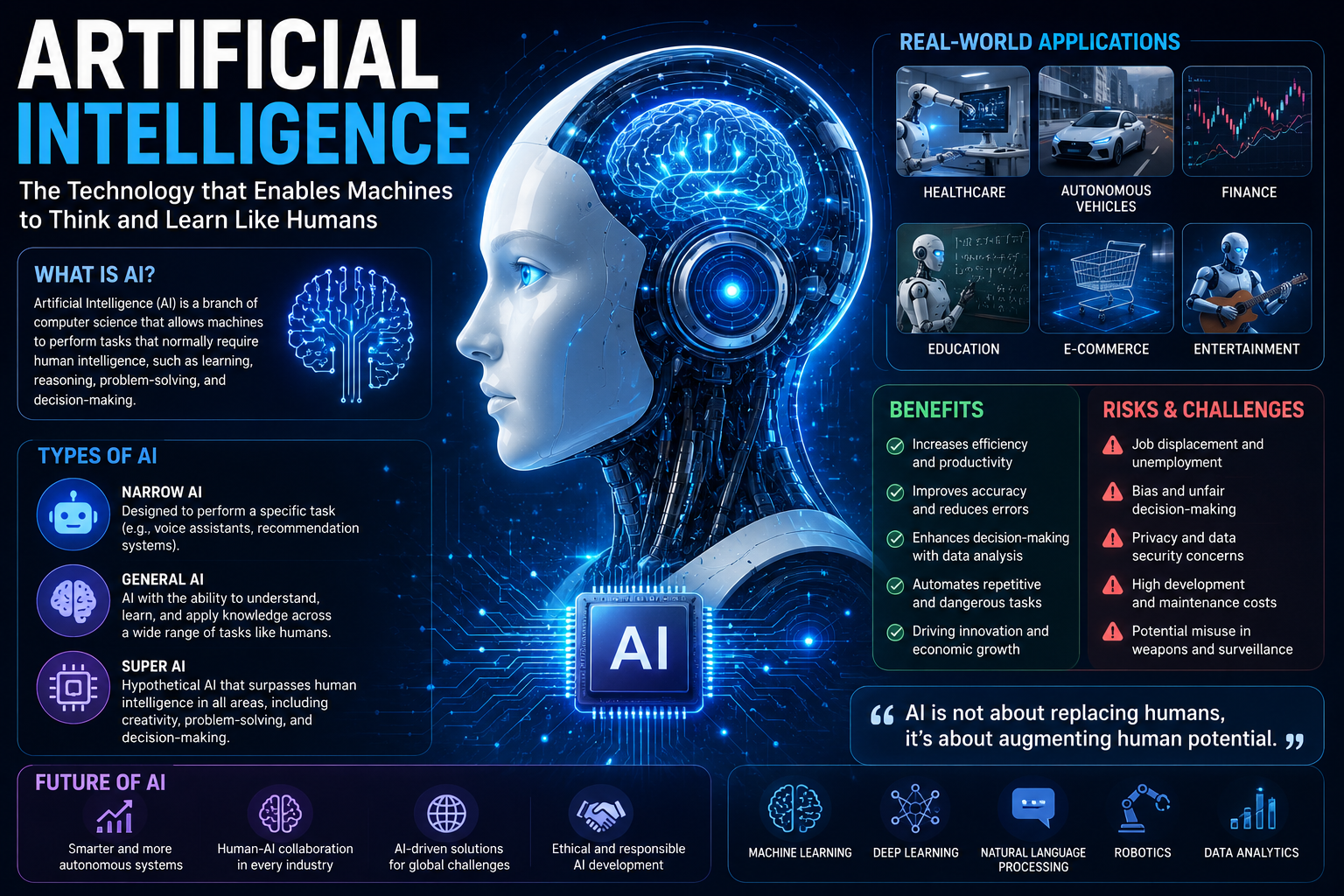
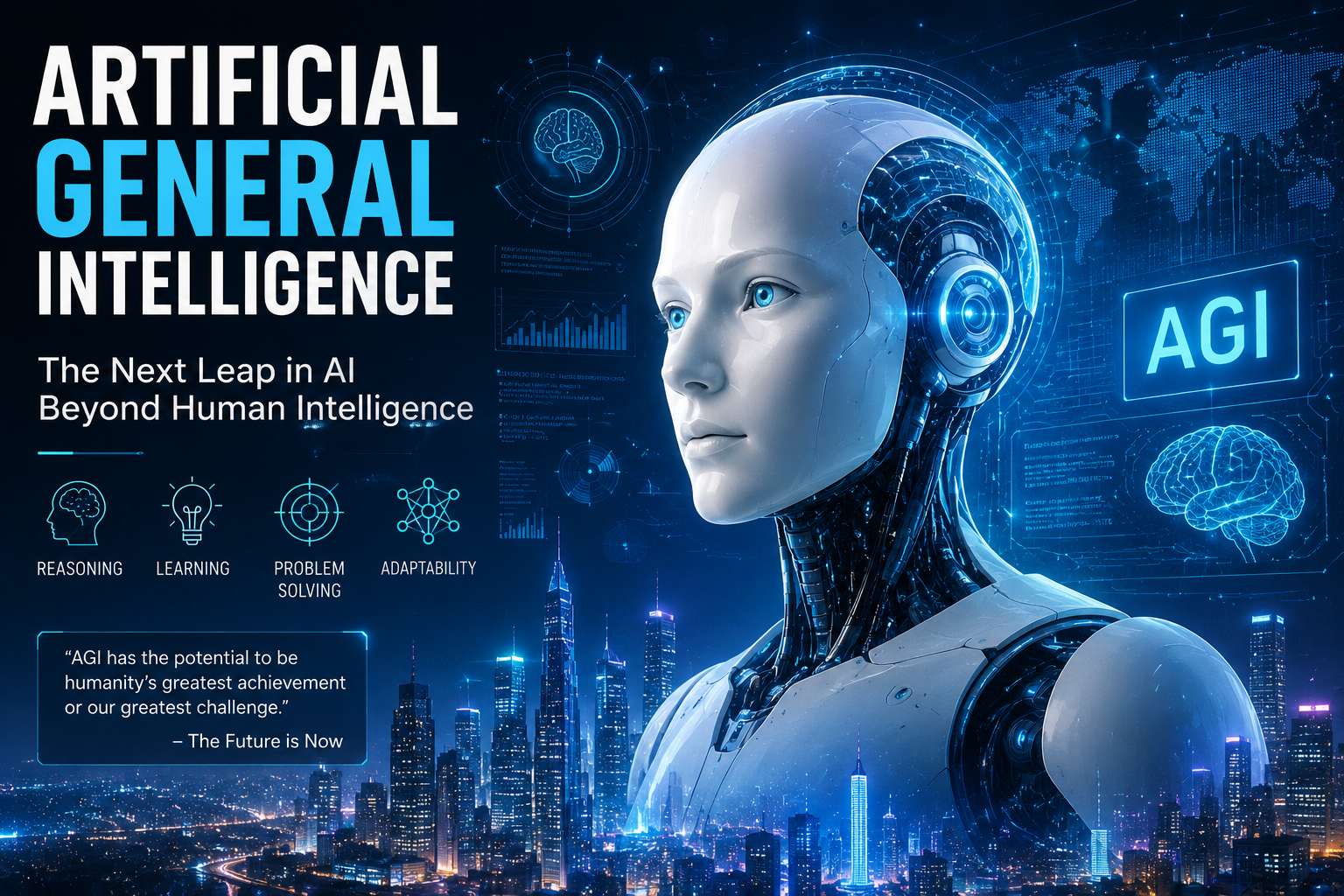
Artificial General Intelligence (AGI) refers to a type of AI that can understand, learn, and apply knowledge across a wide range of tasks — much like a human being. Unlike narrow AI systems, which are designed to perform specific tasks (such as recognizing images or translating text), AGI can reason, plan, and adapt across domains without being explicitly programmed for each one.
In simple terms: narrow AI is a specialist. AGI is a generalist.
1.1 Why Does AGI Matter?
AGI represents one of the most transformative — and debated — milestones in the history of technology. If achieved:
It could accelerate scientific discovery by decades.
It could solve complex global problems (climate, disease, poverty).
It could fundamentally reshape economies, labor markets, and governance.
It raises profound questions about safety, ethics, and human identity.
State of AGI in 2026
As of 2026, we do not yet have AGI. However, the gap between narrow AI and AGI has narrowed significantly. Large Language Models (LLMs) and multimodal AI systems have demonstrated surprising generalization — solving math Olympiad problems, writing functioning code, and performing expert-level medical diagnosis.
Where We Are Today
Capability Domain Current Achievement Maturity Level
Large Language Models Near-human writing, reasoning, coding High
Multimodal AI Image + text + audio understanding High
Autonomous Agents Multi-step task completion, tool use Medium
Embodied Robotics Physical world interaction Low-Medium
World Models True cause-and-effect reasoning Early Stage
Leading Research Organizations
GPT-5, o-series reasoning models; AGI-focused mission: OpenAI
Claude model family; safety-first AGI development: Anthropic
Gemini Ultra, AlphaFold breakthroughs in science: Google DeepMind
Open-source Llama models; academic collaboration: Meta AI
Grok models; real-time information integration: xAI
Specialized and enterprise-focused models: Mistral, Cohere, AI21 Labs
How Current AI Approaches AGI
Large Language Models (LLMs)
LLMs are trained on vast amounts of text data using a technique called self-supervised learning. They learn to predict the next word (or token) in a sequence, which forces them to internalize grammar, facts, reasoning patterns, and even common sense. The largest models (GPT-4, Claude 3, Gemini Ultra) have shown emergent capabilities not explicitly trained for.
Reinforcement Learning from Human Feedback (RLHF)
RLHF is a training technique used to align AI models with human preferences. Human raters evaluate AI outputs; the model learns to produce responses humans find helpful, harmless, and honest. This approach dramatically improved the usability and safety of modern AI assistants.
Reasoning and Chain-of-Thought
A major breakthrough in 2024-2026 was teaching AI systems to reason step-by-step before answering. Models like OpenAI o1/o3 and DeepSeek R1 spend “thinking time” working through problems — dramatically improving performance on complex math, science, and coding tasks.
Autonomous Agents
AI agents combine LLMs with the ability to use tools (web search, code execution, file management) and take multi-step actions over time. Systems like Claude Computer Use, OpenAI Operator, and various open-source frameworks can now autonomously browse the web, write code, fill forms, and manage workflows.
Defining AGI: The Ongoing Debate
There is no universally agreed definition of AGI. Researchers, philosophers, and technologists disagree on what it would mean for an AI to be “general.” Here are the most prominent definitions:
AGI Timelines: Predictions & Forecasts
Predicting AGI timelines is notoriously difficult. Below are estimates from prominent researchers and organizations as of 2026:
Predictor Timeline Estimate
Sam Altman (OpenAI) Within this decade (2030s)
Demis Hassabis (Google DeepMind) Possibly within a decade
Elon Musk (xAI) 2025-2027 (highly optimistic estimate)
Geoffrey Hinton 5-20 years
Yann LeCun (Meta AI) Decades away; requires paradigm shift
Metaculus Prediction Market Median estimate: 2032-2040
AI Impacts Survey (researchers) 50% chance by 2059
The wide variance in estimates reflects genuine scientific uncertainty — AGI arrival depends on yet-unknown breakthroughs in reasoning, memory, embodiment, and alignment.
Risks, Safety, and Ethics
The development of AGI is one of the highest-stakes endeavors in human history. A wide range of risks — from short-term harms to existential threats — must be carefully managed.
Short-Term Risks (Already Occurring)
Misinformation and deepfakes generated at scale
Job displacement in knowledge-work sectors
Algorithmic bias and discrimination
Cybersecurity vulnerabilities from AI-powered attacks
Concentration of AI power in a few corporations
Medium-Term Risks (Emerging)
Autonomous AI systems making consequential decisions without oversight
Loss of human control over critical infrastructure
AI-enabled surveillance and authoritarian control
Economic inequality between AI-enabled and non-AI nations
Long-Term / Existential Risks
Misaligned AGI pursuing goals harmful to humanity
Recursive self-improvement leading to uncontrollable superintelligence
Power seizure by AI or by humans using AI as a tool
AI Safety Approaches
Training AI systems with explicit ethical principles (Anthropic): Constitutional AI
Understanding what happens inside neural networks: Interpretability Research
Stress-testing AI systems for dangerous outputs: Red Teaming
Ensuring humans can supervise increasingly capable AI: Scalable Oversight
Government policies to govern AI development and deployment: Regulatory Frameworks
Economic and Societal Impact
Labor Market Transformation
AGI and current AI will significantly transform labor markets. Studies suggest that 30-60% of tasks in knowledge-work professions (law, medicine, finance, programming) could be automated by 2030. However, AI also creates new roles and industries — historically, technology both displaces and creates jobs.
7.2 GDP and Productivity
Goldman Sachs (2025) estimated that AI automation could add $7 trillion to global GDP over a decade. McKinsey Global Institute projects AI could contribute up to $4.4 trillion annually to the global economy through productivity improvements across sectors.
7.3 Industries Most Affected
Industry AI Application Disruption Level
Healthcare Diagnosis, drug discovery, personalized medicine Very High
Legal Contract review, research, document analysis Very High
Finance Trading, risk assessment, fraud detection High
Education Personalized tutoring, curriculum design High
Creative Industries Writing, design, music generation Medium-High
Manufacturing Quality control, supply chain, robotics Medium
Transportation Autonomous vehicles, logistics optimization Medium
- Governance and Regulation
8.1 Global Regulatory Landscape (2026)
Comprehensive risk-based AI regulation; in force 2024-2026 phased rollout: European Union (EU AI Act)
Executive Order on AI (2023); emerging bipartisan legislative efforts: United States
Pro-innovation approach; AI Safety Institute established (2023): United Kingdom
Generative AI regulations; state-guided development model: China
G7 Hiroshima AI Process; UN Advisory Body on AI: International
Key Governance Principles
AI systems should be explainable and auditable: Transparency
Clear lines of responsibility for AI decisions: Accountability
Mandatory testing before deployment of frontier models: Safety
Prohibition on discriminatory AI applications: Fairness
Humans must retain meaningful control over high-risk AI: Human Oversight
The Road to AGI: What Comes Next?
AI that truly understands cause-and-effect in the physical world: World Models
Persistent, structured memory across conversations and tasks: Long-Term Memory
Moving beyond statistical correlation to true understanding: Causal Reasoning
Integration with physical systems (robots) to learn from the world: Embodiment
AI that learns how to learn efficiently with minimal data: Meta-Learning
Reliably encoding human values into increasingly capable systems: Robust Alignment
The Post-AGI World: Scenarios
Scenario Description Assessment
Cooperative AGI AGI developed safely; used to solve global challenges Best case
Gradual Transition AGI emerges slowly; society adapts over decades Hopeful
Uneven Distribution AGI benefits flow to few; inequality rises sharply Concerning
Loss of Control AGI misalignment causes large-scale harm Dangerous
Superintelligence Recursive self-improvement leads to uncontrollable ASI Existential risk
The Critical Window
Many AI safety researchers argue that the decisions made in the next 3-10 years — about how to develop, deploy, and govern AI — will be among the most consequential in human history. The choices made now will shape the trajectory of AGI and its impact on humanity.
- Glossary of Key Terms
Term Definition
AGI Artificial General Intelligence — AI that can perform any intellectual task a human can
ASI Artificial Superintelligence — AI that surpasses human intelligence in all domains
LLM Large Language Model — AI trained on massive text data (GPT-4, Claude, Gemini)
RLHF Reinforcement Learning from Human Feedback — training AI to align with human values
Alignment The challenge of ensuring AI systems pursue goals beneficial to humanity
Emergent Behavior Unexpected capabilities that arise in large AI models not explicitly trained
AI Agent An AI system that can take multi-step actions to complete goals autonomously
Interpretability Research into understanding the internal workings of neural networks
Hallucination When an AI generates confidently stated but factually incorrect information
Transformer The neural network architecture underlying most modern large AI models
Fine-tuning Additional training of a base model for specific tasks or domains
Multimodal AI AI that can process multiple types of input: text, image, audio, video
Conclusion
Artificial General Intelligence remains the defining technological challenge of our era. In 2026, we stand at a pivotal moment — closer to AGI than ever before, yet still navigating fundamental unsolved problems in reasoning, alignment, and safety.
The path to AGI is not just a technical journey. It is a societal, ethical, and political one. The question is not merely whether we can build AGI — but whether we can build it wisely, equitably, and safely. That responsibility belongs to researchers, governments, companies, and citizens alike.
Final Thought
AGI is not inevitable — but it is plausible within our lifetime. Whether it becomes humanity’s greatest achievement or its greatest risk depends on the choices we make today. Stay informed. Stay engaged. The future of intelligence is being written now.