Table of Contents
- What Is ICT?
- A Brief History of ICT
- Core Components of ICT
- Networking & the Internet
- Cloud Computing
- Cybersecurity in ICT
- ICT Across Industries
- ICT in Education
- ICT Trends in 2026
- Challenges & Ethical Issues
- Conclusion & Future Outlook
What Is Information and Communication Technology?
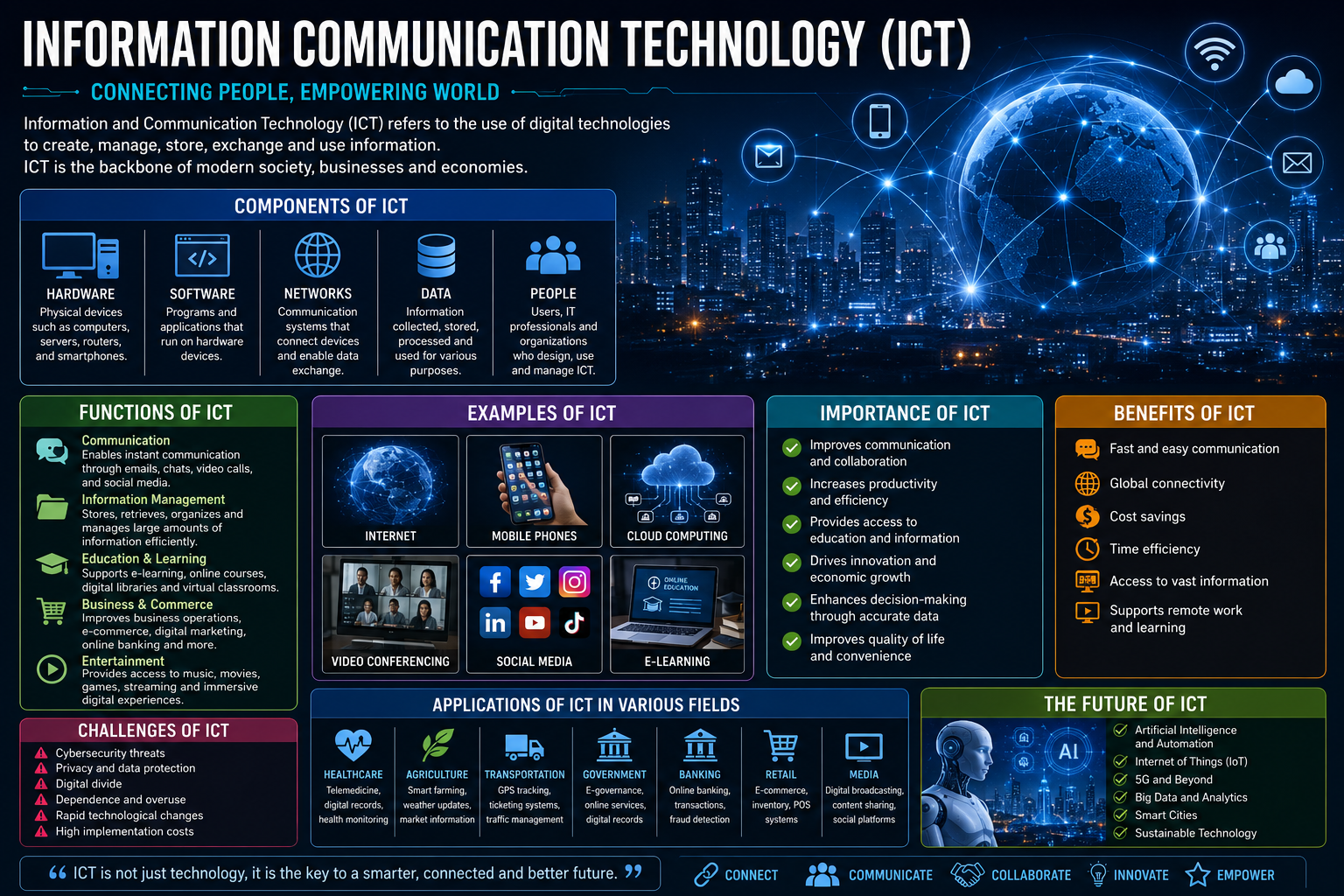
Information and Communication Technology (ICT) is an umbrella term that encompasses all technologies used to handle, process, store, transmit, and receive information. It integrates telecommunications (telephone lines, wireless signals, satellite links), computers, software, middleware, storage systems, and audiovisual systems to enable users and organizations to interact with digital information.
ICT is not a single technology but a convergence — the meeting point of computing, telecommunications, and media. Where once these were separate industries, they have fused into a single, deeply interconnected ecosystem that underpins modern economies, governments, businesses, healthcare, education, and daily life.
📌 Definition
The International Telecommunication Union (ITU) defines ICT as technologies that provide access to information through telecommunications — including the Internet, wireless networks, mobile phones, computers, and other communication mediums for creating, storing, and exchanging information.
The distinction between “information technology” (IT) and “communication technology” (CT) has largely dissolved. Virtually all modern IT involves communication, and virtually all modern communication is mediated by computing. ICT captures this convergence as a unified field of study, policy, and practice.
A Brief History of ICT
The story of ICT is the story of humanity’s accelerating ability to create, move, and use information. Each era has been defined by a transformative leap in how information is processed and communicated.
1830s–1900s
Electrical Communication Foundations
The telegraph (1837) and telephone (1876) establish the principle of electrical long-distance communication. Radio telegraphy follows in the 1890s.
1940s–1950s
Birth of Electronic Computing
ENIAC (1945) and early mainframes prove that electrical machines can process information at scale. Transistors replace vacuum tubes, enabling smaller, faster machines.
1960s–1970s
Networking & ARPANET
ARPANET (1969), the precursor to the modern internet, enables computers to communicate across distances. Packet-switching technology is invented.
1980s
Personal Computing & Early Networks
IBM PCs and Apple Macintosh bring computing to individuals. LANs (Local Area Networks) connect office machines. The term “ICT” begins to emerge in policy discourse.
1990s
The World Wide Web & Global Internet
Tim Berners-Lee’s World Wide Web (1991) and the commercialization of the internet transform ICT from an academic/military tool to a public, global infrastructure.
2000s–2010s
Mobile, Social & Cloud Computing
Smartphones, social media platforms, and cloud computing reshape how billions interact with ICT daily. 3G and 4G networks make mobile internet ubiquitous.
2020s–2026
AI, 5G/6G, Edge Computing & Convergence
Artificial intelligence permeates ICT at every layer. 5G is widespread; 6G research advances. Edge computing, IoT, and quantum networking define the frontier.
Core Components of ICT
ICT is a system of systems. Understanding it requires understanding its major building blocks and how they interact.
🖥️
Hardware
Physical devices: computers, servers, smartphones, routers, switches, storage drives, and IoT sensors. The tangible infrastructure of ICT.
💾
Software
Operating systems, applications, middleware, and firmware that instruct hardware what to do. From office apps to enterprise ERP systems.
🌐
Networks
LANs, WANs, the internet, cellular networks, and satellite links — the infrastructure connecting ICT components across distances.
📡
Telecommunications
Telephone systems, mobile networks (4G/5G), fiber optic cables, and satellite communication enabling voice and data transfer.
☁️
Cloud Services
On-demand computing resources — storage, processing, applications — delivered over the internet without local infrastructure.
🗄️
Data & Databases
Structured and unstructured data stored in relational databases, data warehouses, data lakes, and distributed file systems.
🔐
Security Systems
Firewalls, encryption, identity management, intrusion detection, and security protocols protecting ICT systems from threats.
🤖
AI & Analytics
Machine learning, natural language processing, and business intelligence tools that extract value and intelligence from data.
Networking & the Internet
Networking is the connective tissue of ICT. Without the ability to transmit data between devices and systems, information technology would be isolated and far less powerful. Computer networking involves the interconnection of computing devices to share resources and exchange data.
Types of Networks
LAN (Local Area Network) — connects devices within a limited area such as an office or campus, typically via Ethernet or Wi-Fi. WAN (Wide Area Network) — spans large geographic areas, with the internet being the world’s largest WAN. MAN (Metropolitan Area Network) — covers a city or region. PAN (Personal Area Network) — very short-range networking, such as Bluetooth connections between nearby devices.
The Internet & TCP/IP
The internet operates on the TCP/IP protocol suite — a set of communication standards that govern how data is broken into packets, routed across networks, and reassembled at the destination. Every connected device has an IP address, and the Domain Name System (DNS) translates human-readable domain names (like technologyhub.com) into IP addresses machines can route to.
5G and Beyond
Fifth-generation (5G) mobile networks are now widely deployed globally in 2026, offering peak download speeds up to 20 Gbps, sub-millisecond latency, and the capacity to connect massive numbers of IoT devices simultaneously. 6G research — targeting terahertz-frequency communication and sub-0.1ms latency — is underway at academic and government labs worldwide.
📡 Network Generation Comparison
4G LTE: ~100 Mbps typical · 5G: up to 20 Gbps peak, ~1ms latency · 6G (projected): up to 1 Tbps, sub-0.1ms latency, spatial computing support, target deployment ~2030.
Cloud Computing
Cloud computing has fundamentally transformed ICT infrastructure by making computing power, storage, and software available on-demand over the internet — eliminating the need for organizations to own and operate all their own hardware.
Cloud Service Models
| Model | What’s Provided | User Manages | Example Providers |
|---|---|---|---|
| IaaS — Infrastructure as a Service | Virtual machines, storage, networking | OS, runtime, apps, data | AWS EC2, Azure VMs, Google Compute Engine |
| PaaS — Platform as a Service | Development platform, databases, middleware | Applications and data | Heroku, Google App Engine, Azure App Service |
| SaaS — Software as a Service | Fully managed applications | Configuration and data only | Microsoft 365, Salesforce, Slack, Gmail |
| FaaS — Function as a Service | Serverless code execution | Code logic only | AWS Lambda, Azure Functions, Cloudflare Workers |
Cloud Deployment Models
Public Cloud — infrastructure shared across many organizations, operated by providers like AWS, Microsoft Azure, or Google Cloud. Private Cloud — dedicated infrastructure for a single organization, hosted on-premises or by a third party. Hybrid Cloud — a mix of public and private cloud resources with orchestration between them. Multi-cloud — using services from multiple public cloud providers to avoid vendor lock-in and optimize performance and cost.
Cybersecurity in ICT
As ICT systems have become indispensable to every aspect of modern life, they have also become prime targets for malicious actors. Cybersecurity — the practice of protecting ICT systems, networks, and data from unauthorized access, damage, or attack — has become one of the most critical disciplines within the ICT field.
Common Cyber Threats
Malware (viruses, ransomware, trojans) infiltrates systems to steal data or extort money. Phishing tricks users into revealing credentials or installing malicious software via deceptive communications. DDoS (Distributed Denial of Service) attacks overwhelm servers with traffic to disrupt services. Man-in-the-Middle attacks intercept communications between two parties. Zero-day exploits take advantage of unknown vulnerabilities before patches are available. Insider threats originate from within an organization through negligence or malice.
Key Cybersecurity Frameworks
Organizations in 2026 widely adopt structured frameworks to manage cybersecurity risk. The NIST Cybersecurity Framework (Identify, Protect, Detect, Respond, Recover) is the most widely referenced standard globally. The ISO/IEC 27001 standard provides requirements for an information security management system (ISMS). The Zero Trust Architecture model — “never trust, always verify” — has become the dominant paradigm for modern enterprise security, eliminating assumptions of implicit trust within network perimeters.
🔐 2026 Security Highlight
Post-quantum cryptography standards finalized by NIST in 2024 are now being actively deployed across critical infrastructure and government systems in 2026 to protect against the threat of quantum computing breaking current encryption standards.
ICT Across Industries
ICT is not merely a sector unto itself — it is the enabling infrastructure of virtually every other sector. Its transformative impact is felt across healthcare, finance, agriculture, government, manufacturing, transportation, and beyond.
Healthcare & Medicine
Electronic Health Records (EHRs), telemedicine platforms, AI-assisted diagnostics, wearable patient monitoring devices, robotic surgery systems, and pharmaceutical research computing are all ICT-enabled. In 2026, AI models assist in early cancer detection, drug discovery, and personalized medicine at scale.
Finance & Banking
Online banking, mobile payments, real-time stock trading, blockchain-based transactions, AI-powered fraud detection, and robo-advisors are transforming financial services. Digital currencies and central bank digital currencies (CBDCs) represent the frontier of ICT in finance.
Agriculture (AgriTech)
Precision agriculture uses IoT sensors, drone imagery, GPS-guided machinery, and AI-driven analytics to optimize crop yields, reduce water usage, and monitor soil health in real time — turning farming into a data-intensive discipline.
Government & Public Services
E-government platforms deliver public services online, reducing bureaucracy. Smart city infrastructure uses ICT to manage traffic, energy grids, public safety, and waste management. Digital identity systems enable secure citizen authentication.
Manufacturing
Industry 4.0 integrates ICT deeply into manufacturing through IoT-connected machines, digital twins, predictive maintenance systems, AI-driven quality control, and robotics. The result is the “smart factory” — a highly automated, data-driven production environment.
Transportation & Logistics
GPS, real-time fleet tracking, route optimization algorithms, autonomous vehicles, smart traffic management, and drone delivery systems all depend on ICT infrastructure. Aviation, shipping, and rail are deeply dependent on ICT for safety and efficiency.
ICT in Education
Education has been profoundly transformed by ICT — both as a subject of study and as a medium through which learning is delivered. The COVID-19 pandemic accelerated the adoption of digital learning tools by years, and the educational landscape of 2026 is fundamentally different from that of a decade ago.
Digital Learning Tools
Learning Management Systems (LMS) such as Moodle, Canvas, and Blackboard enable schools and universities to deliver course content, assignments, and assessments online. Video conferencing (Zoom, Microsoft Teams), interactive whiteboards, and simulation software enrich both in-person and remote learning experiences.
AI Tutors & Personalized Learning
AI-powered adaptive learning platforms analyze each student’s performance and adjust the difficulty and style of content delivery to match individual learning needs. Conversational AI tutors provide instant, personalized feedback on exercises and explanations.
🎓 ICT as a Curriculum Subject
ICT is taught as a core subject in schools worldwide, covering digital literacy, programming fundamentals, data handling, online safety, and computational thinking — skills increasingly essential in every professional field.
The Digital Divide
Despite progress, a significant global digital divide persists. Approximately 2.6 billion people remain without internet access as of 2026, concentrated in Sub-Saharan Africa, South Asia, and rural regions worldwide. Bridging this divide remains one of the central challenges of international ICT policy.
ICT Trends in 2026
The ICT landscape in 2026 is being shaped by several powerful, intersecting trends that are redefining what technology can do and how organizations and individuals interact with it.
Generative AI & Large Language Models
Generative AI has moved firmly from experimental to mainstream. Large Language Models (LLMs) and multimodal AI systems are embedded in productivity software, customer service platforms, development tools, content creation workflows, and decision-support systems. AI co-pilots are now standard in coding environments, document drafting, and data analysis.
Edge Computing & Distributed Intelligence
Rather than sending all data to centralized cloud servers, edge computing processes data at or near its source — on local servers, gateways, or the devices themselves. This reduces latency dramatically, enables real-time decision-making for autonomous vehicles and industrial machines, and reduces bandwidth costs for IoT deployments.
Quantum Computing — Approaching Practical Use
Quantum computing has advanced significantly. While fault-tolerant, general-purpose quantum computers remain on the horizon, quantum advantage has been demonstrated for specific optimization and simulation tasks relevant to pharmaceuticals, materials science, logistics, and cryptography.
Spatial Computing & Extended Reality (XR)
The convergence of Augmented Reality (AR), Virtual Reality (VR), and Mixed Reality (MR) into “spatial computing” is creating new ICT interfaces for training, design, healthcare, and collaboration. Lightweight AR glasses and headsets are gaining enterprise adoption for remote assistance and hands-free workflows.
Sustainable ICT & Green Technology
The energy consumption of data centers and ICT infrastructure has become a major concern. In 2026, hyperscalers are aggressively investing in renewable energy, liquid cooling, AI-optimized power management, and hardware efficiency to reduce the carbon footprint of global ICT infrastructure.
Cybersecurity AI — Attackers & Defenders
AI is now central to both cyberattacks and cyber defense. AI-powered threat detection systems identify anomalies and respond to incidents faster than human analysts. On the other side, AI is used to generate more convincing phishing content, discover vulnerabilities, and automate attack campaigns.
Challenges & Ethical Issues in ICT
The rapid advancement of ICT brings with it a set of significant challenges — technical, social, ethical, and political — that societies and organizations must navigate carefully.
Major Challenges
- Bridging the global digital divide
- Escalating cybersecurity threats
- Environmental impact of data centers
- Workforce displacement from automation
- Data privacy and surveillance concerns
- Misinformation and deepfake proliferation
- Regulatory lag behind technology pace
Ethical Debates
- AI bias and algorithmic fairness
- Right to be forgotten vs. data retention
- Autonomous weapons and lethal AI
- Digital monopolies and market power
- Child safety in digital environments
- Ownership of AI-generated content
- Surveillance capitalism & data exploitation
Data Privacy & Regulation
The collection, processing, and commercialization of personal data by ICT platforms has prompted regulatory responses worldwide. The EU’s General Data Protection Regulation (GDPR), California’s CCPA, and a growing number of national data protection laws impose obligations on organizations handling personal information. In 2026, AI-specific regulation — including the EU AI Act now in enforcement — adds a new layer of compliance requirements for ICT systems that use machine learning.
ICT Is the Foundation of Our Digital Future
Information and Communication Technology is not simply one sector of the economy — it is the foundational infrastructure upon which the modern world operates. From the smartphone in your pocket to the server farms powering global finance, from rural telemedicine to urban smart-city management, ICT touches every dimension of human life.
In 2026, ICT is accelerating rather than plateauing. The convergence of artificial intelligence, 5G/6G connectivity, edge computing, quantum processing, and spatial interfaces is creating a technological environment of unprecedented complexity and capability. The institutions, organizations, and individuals who understand and effectively engage with ICT will be those best positioned for the decades ahead.
Staying informed, digitally literate, and critically engaged with how ICT shapes society is not optional — it is a defining competency of the 21st century.
// ICT Quick Facts
Global Market 2026~$7.3T
Internet Users5.6 Billion
Mobile Connections8.9 Billion
IoT Devices~42 Billion
5G Networks300+ Countries
Data Created Daily~3.5 ZB/yr
Cybercrime Cost/yr~$12T
Without Internet~2.6B people
// Key Glossary ICTInformation & Communication Technology IoTInternet of Things — networked physical devices IaaS / PaaS / SaaSCloud service delivery models LAN / WANLocal / Wide Area Network DNSDomain Name System Zero TrustSecurity model: never trust, always verify Edge ComputingProcessing data near its source LLMLarge Language Model (generative AI) XRExtended Reality (AR + VR + MR) GDPREU General Data Protection Regulation DDoSDistributed Denial of Service attack EHRElectronic Health Record
// Related Articles
CNC Machining Guide 2026Cloud Computing Explained: AWS vs Azure vs GCPCybersecurity Best Practices 2026Introduction to AI & Machine Learning5G vs 6G: What’s the Difference?The IoT Ecosystem: A Complete Guide
© 2026 TechnologyHub · All content is for informational purposes only · malikhamzaayub123@gmail.com